
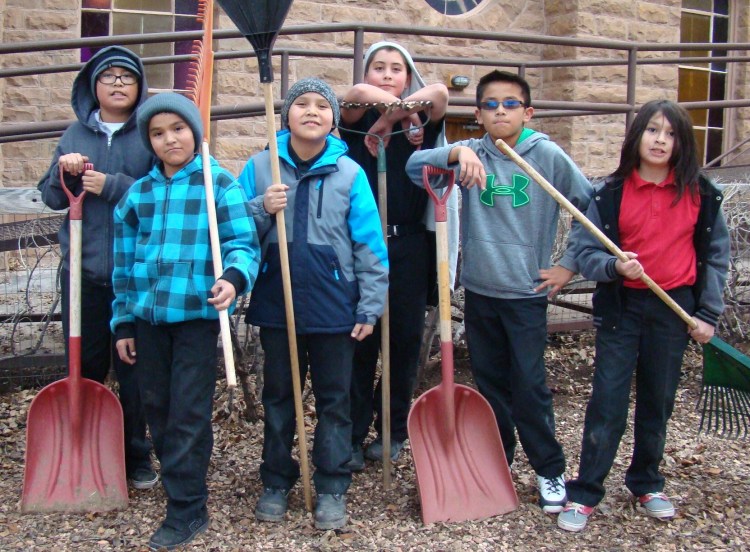
School and community gardens should be at the heart of a transformational revolution in our educational system and economy, politics, religion, healthcare, our relationships to one another, and everything about the way we live on this beautiful planet. It should be clear to everyone by now that we are living in a period of rapid and profound technological, political and ecological change. Unfortunately, the manner in which we continue to conduct the business of our daily lives has not kept up with these changes. We remain stuck in outdated patterns of behavior and ways of thinking, supported by economic and educational systems and infrastructures that are out-dated and out of touch with the problems we are facing (in fact, are themselves a major part of the problem.)
The future is happening NOW, while we continue to live in the past. Our simple actions, and lack of action, right now, today, are shaping the world we will be living for generations to come. It appears that we are proceeding mindlessly but it may be that we are simply unaware of the consequences of our actions and unaware of our options for making positive changes. Where can we go to learn what we need to know?
Back to school.
I taught high school earth science and environmental science classes for a couple of years to students who were not very interested in the curricula I was presenting and not very motivated to read the textbook or pay attention to videos such as The Eleventh Hour or Racing Towards Extinction. It could be that I was not a very good teacher, but it also seemed that my students simply had too many other things on their minds. Saving the whales and orangoutangs and the planet would be nice but it’s hard to fit that in with their busy schedules. And if saving the planet was really something important and urgent to do, then why weren’t they hearing about it from their other teachers or their parents? Having a winning basketball team was obviously more of a priority based on the amount of time and resources allotted to it.
Winning, or loosing, a basketball game yields immediate tangible results that can be felt emotionally and celebrated, or commiserated. Even just practicing, actively running around and honing the skills of passing the ball or scoring points is more engaging and satisfying than sitting in a classroom. As a society, we need more physical activity to maintain good health. School sports programs have value in this regard and sports bring us together around working to accomplish a shared purpose (winning the game) and challenging ourselves individually to reach for some personal accomplishment. How can we make a game out of transforming civilization?
Many of us have accepted the simplistic equation People = Bad and therefore More People = More Bad, Less People = Less Bad. This may seem logical, but it is based on a variable subjective assumption (the badness/goodness of people) and it is not helpful anyway at this point. We need to take action now, not at some future point in time when there may be more, or less, people. How can we make people good for the Earth and good for each other?
Humanity is faced with some very real and immediate challenges. We need to understand that people, themselves, are not the problem, too many people are not the problem either. Worrying about overpopulation is not helping at this point. A relatively small number of European settlers moving west across North America 150 years ago was enough to devastate the highly productive ecosystem of the Great Plains, wiping out the vast herds of bison that had been sustainably supporting a large number of Native People (a much larger number than history books have accounted for.)
The agricultural practices these settlers introduced tore up the grasslands and accelerated soil erosion far beyond sustainable limits leading to a rapid drop in overall ecological productivity and replacing it with the beginnings of an industrialized model of productivity based on marketable agricultural commodities. The economic profits generated by these methods came at the cost of losing the more subtle benefits provided by a healthy, fully functional ecosystem. These benefits are of enormous economic value but are completely taken for granted or ignored and are not figured into any of the economic calculations made by the economists who have been charting the course of our economic and social development for the past century.
Even while a small number of people can devastate an ecosystem, a large number of people can, potentially, strengthen and increase the abundance of an ecosystem. We could actually be employing a large number of people to repair the ecosystems we have damaged. We need to start thinking of people as assets to Planet Earth’s biosphere rather than as a liability. And we need to start behaving accordingly.
One crucial change that our advanced technology has brought us is a vastly increased ability to be productive, so much so that we have over-shot our needs and are now overprotective. To accommodate this overproduction, we produce stuff that can be disposed of as quickly as it can be produced, such as “single use” plastic items, appliances intentionally designed to have a short lifespan and are not repairable, and things that we simply don’t need and wouldn’t purchase except that we have been convinced by advertising these things will somehow improve the quality of our lives. (Advertising is a form of education that is mind-numbing and toxic to society as a driver of self-destructive behavior.)
Overproduction is an insanely wasteful thing to be doing. If we focus on producing just what is needed to have a good life, we can greatly ramp down our overall production, which would be a tremendous cost savings to humanity. One minor temporary issue is that this would leave hundreds of millions of people unemployed, but this actually a beautiful circumstance and the key to our amazing new future prospects as a civilization. To begin to enjoy this circumstance, we need to adjust the rules of our economic system so that the benefits of increased efficiency in productivity are shared by everyone.
Of the current jobs that remain in this readjusted economy, these positions could be shared by some of the newly unemployed, by reducing the amount of hours per week that a person works. Freeing up workers to enjoy more time to spend as they wish, and still earn all the money required to meet their needs and pursue their interests. Some sectors of the job market would see a very large increase in the number workers. Teachers, emergency response, care givers, full time parenting and caring for family members. Even if a person chooses not to work or can’t work for any reason we, as a humane humanity are wealthy enough to provide that person all the essentials of a comfortable life, access to free education or vocational training and, if needed, any medical services or psychological/emotional counseling.
There is such an abundance to be shared that there really is nothing that we need to fight over. By sharing, we eliminate the scarcity that tempts desperate people to commit crimes in order to provide the basic necessities of life for their families themselves, and we eliminate the need for war. The cost savings realized from a major drop in crime would be huge, and eliminating military spending would be even greater.
Welcome to the Slow Economy
The “Slow Food” movement has made people more aware of the consequences of our food choices, enabled us to enjoy what we eat more and improved our mental and physical health. The Slow Economy offers even more benefits.
We no longer need to work long hours just to survive and provide for our families. We can all take time to relax and enjoy life, to care for one another, to pursue our interests, to explore our curiosity and creativity, to go back to school (for free) or spend more time with our family.
We simply need to start living within the parameters and ability of the Earth’s biosphere to support human civilization. The limits of those parameters are determined by our creativity and inventiveness, and by our knowledge and understanding of how Nature works. Should we start taking shorter showers to conserve water and the energy it takes to heat the water? What if the water is solar heated (super easy technology that can work even in cold and overcast weather) and the “waste” water is piped directly to a biological filtering system that converts the waste materials into food for plants, provides water for the plants to grow, and in turn provides food for us (from the plants) and fresh clean water too. The heat in the water going down the shower drain can be transferred to help heat the building we are in if the weather is cold, or the heat can be stored (in thermal mass) for later use.
We know how to do this, Many of these systems have already been built and have been in operation for years now, and more are being planned. These same design principles are being used in developing systems for colonies on the moon and on Mars, and for enabling New York City to produce all of its food and recycle all of its waste within its city limits. It is cutting edge high-technology and it is as old as life on Earth. It is mimicking how Nature works (biomimicry.) The point is that we do not have to sacrifice anything pertaining to our creature comforts, we just need a design change in the way we go about providing for those comforts. We need to start teaching these design principles in school because this is what a lot of people are going to be doing for employment in the very near future, if we are going to have a future.
To be continued…
 Sunrise Ecological Education & Design Services